

Michigan Scientific offers a wide variety of electronics including signal conditioning equipment. We design and manufacture low noise strain gauge differential amplifiers, thermocouple amplifiers, and remote amplifier control units with many different configurations.

Michigan Scientific provides precision low noise differential amplifiers for strain gage bridges and thermocouples.

12-Channel Analog to CAN Modules designed for high-channel-count measurement applications.
The MUX combines multiple sensor inputs into a single high-speed digital output, streamlining data acquisition for complex test environments such as rotating machinery and automotive components.
The MUX combines multiple sensor inputs into a single high-speed digital output, streamlining data acquisition for complex test environments such as rotating machinery and automotive components.

The PS-AC controls the amplifiers, and the excitation to strain gage bridges, and commands spinning strain gage amplifiers to apply their internal shunt calibration resistor to the appropriate arm of the strain gage bridge.
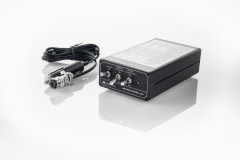
The PS-DC controls the amplifiers, and the excitation to strain gage bridges, and commands spinning strain gage amplifiers to apply their internal shunt calibration resistor to the appropriate arm of the strain gage bridge.
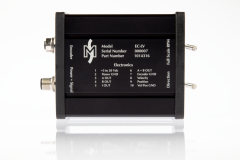
The EC-LV is an encoder signal conditioner, which can be used to convert the digital pulses of the Wheel Pulse Transducer (WPT) or some slip ring assemblies with built in encoders into linear voltages.
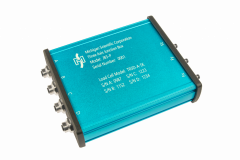
The JB3 combines the signals from multiple TR3D Load Cells and outputs the total force acting on a load cell array or load platform.
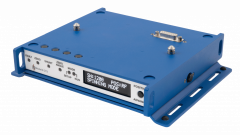
In real-time, the CT3 performs coordinate transformation, cross-talk correction, offset correction, and polarity correction.
The CT3 also has easy to initiate Zero, Shunt Calibration, and Zero Angle features which makes WFT set-up simple and quick.
The CT3 also has easy to initiate Zero, Shunt Calibration, and Zero Angle features which makes WFT set-up simple and quick.
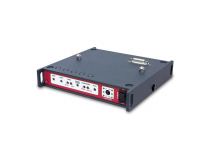
The model CT2 transforms measurements from rotating coordinates into stationary SAE coordinates.
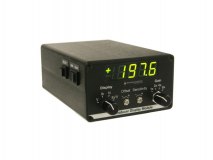
The Transducer Display Module is designed to provide a quick-read display for strain-gage based load cells and transducers.