Automotive
Wheel Torque Transducer Instrumentation Assembly with Slip Ring |
|
![]() |
|
![]() |
Timing Gear Dynamic Strain |
|
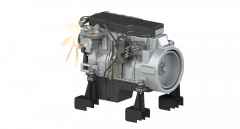
An engine manufacturer needed to know the dynamic strains at the roots of timing gear teeth. They installed thirteen strain gages on the gear. The wires from the gages were brought through a flexible coupling to an array of 13 spinning amplifiers. The customer fabricated a simple and effective shaft and bearing system to support the amplifiers and slip ring. Bridge completion resistors were located at the amplifiers. Power to the amplifiers and high level output signals from the amplifiers were connected to power supplies and recording instruments through a 20 circuit slip ring assembly. This set up was used for several months in a dynamometer cell for diagnostic testing and evaluations of design revisions. |
|
Railroad
Wheelset Transducer Electronics |
|
To evaluate the dynamic stability of newly designed rolling stock, the forces between the wheels and the rail must be determined. The standard wheels are used as a transducer so the strength of the test wheel set is not compromised. As a result, the measurable strains are quite small. Michigan Scientifics' spinning signal conditioners (model AMPEH2-HS), weatherproof slip rings and precision anti-aliasing filters are used to process the strain gage signals. In spite of severe vibration, shock, dust, snow, and rain; accurate strain signals are recorded from minus 40deg F to plus 200 deg F. We have developed computer models which analyze the dynamic interactions of the products being shipped with the railroad environment. |
|
Military
Drivetrain Power Level Analysis |
|
To evaluate the options for improving the speed and efficiency of this military vehicle, Michigan Scientific developed instrumentation to measure power levels throughout the drive line. Tests at a military base quantified the power loss for each drive train component and identified the system components with the greatest potential for design improvement. Processed data was available at the test site within minutes following each test run. This resulted in quick determination of the significant test conditions and complete characterization of the drive train system was achieved in minimal test time. |
|