

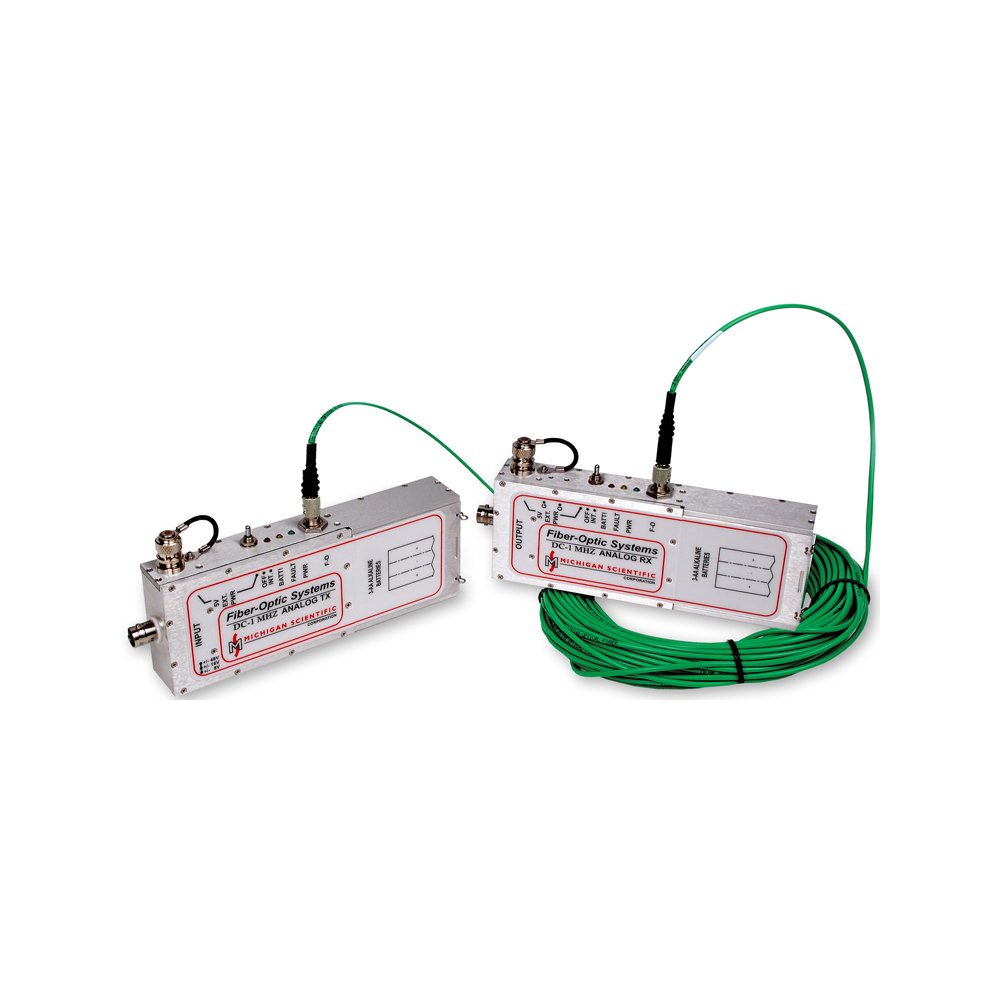
Features
- Monitor/Stimulate equipment from DC to 1 MHz
- RFI/EMI validated
- Low-Power Circuitry
- TX slide-switch provides full-scale input ranges
- RX jumpers provide selectable full-scale output ranges
Description
The FO-HBST (transmitter) and FO-HBSR (receiver) form a versatile fiber-optic, analog signal pair. A DC to 1 MHz voltage signal is monitored or sourced to the device under test (DUT) by connecting to either the FO-HBST or FO-HBSR. A fiber-optic cable connects to the corresponding module to monitor or source the desired signal remotely. Full-scale input level on the transmitter is easily changed by a 3-position slide switch to ±8 V, ±16 V, or ±48 V. The receiver outputs up to ±16 V regardless of the input range.
Each module may be powered by 3-AA batteries or an external power adapter. Both modules have shielding and custom input/output filtering that provides high immunity from electromagnetic interference (EMI), electromagnetic pulse (EMP), or high voltages associated with plasma research. This allows for rigorous electromagnetic compatibility (EMC) testing/engineering. The satellite modules are validated for EMC up to 200 V/m (46 dBV/m) at 500 kHz to 18 GHz and 600 V/m (pulsed 5 % duty-cycle, 5 μs rise-time) 1 GHz to 2.5 GHz.
Documents

Last Modified: [last-modified]