

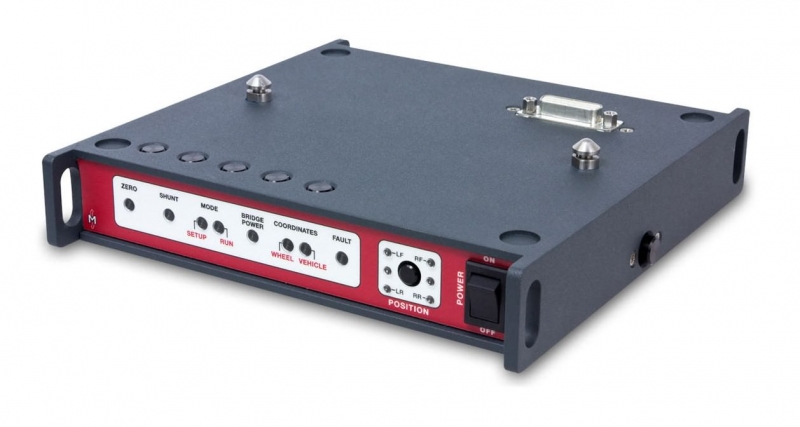
Features
- Analog, CAN, and Ethernet outputs
- Automated zero and shunt features
- Rugged construction
- Wide range 10 to 36 Vdc power
- Field upgradable by user
- Transforms data from wheel to vehicle coordinates
- Stackable with communication between systems
- Ethernet communication via web browser
- Works with data acquisition software to record data directly to a computer
Description
The WFT User Interface Electronics (CT2) provides high level CAN, Ethernet, and analog outputs. The CT2 accepts either analog or digital signals from the Wheel Force Transducer (WFT). In addition, CT2 can also accept built in WFT accelerometer signals. All the signals together can be transmitted to the data acquisition system or computer through the digital outputs.
Setup of the WFT system is done through an embedded webpage and no additional software is required. Firmware upgrades are done by the customer in the field using the same webpage. Coordinate transformation of the data, from wheel to vehicle coordinates, is performed automatically when used on the road. For use on a simulator, wheels do not rotate, and data can be sent directly from the WFT without coordinate transformation.
Factory calibration and setup data is read from the WFT at startup. The CT2 updates the WFT with every zero, shunt sequence check, and set-up change. Calibration files are stored in the WFT, so they never need to be downloaded by the user even if power is interrupted. All CT2 systems can be interchanged with any compatible Michigan Scientific WFT.
When multiple WFTs are used on one vehicle, the CT2 units are stacked together, and communication is shared between electronics. The power requirements are approximately 10 watts per WFT system.
Documents


Last Modified: [last-modified]